If you're an experimental poet, or a lover of various poetry forms, it's inevitable that short forms, including haiku, and tanka, will come into your life. Haiku, a three line Japanese poem, imbued with elements of nature and time, has made a successful transition to the Western poetry tradition, in part due to the popularity of Basho's Narrow Road to the Interior, and beat writers like Jack Kerouac, though not in its original form, and often, as an instructional tool by teachers to convey an appreciation for poetry to junior high/high school students.
Tanka, the progenitor to haiku, is a popular, and widely respected poetry form in Japan, and a recent import to the United States, Europe, and Australia. Tanka differs in form in that it has two additional lines, has more musicality (tanka, translated means "short song"), and gives the poet more opportunity to "tell a story", than haiku. Tanka can be more challenging to craft than haiku, but the results, in my opinion, are more satisfying.
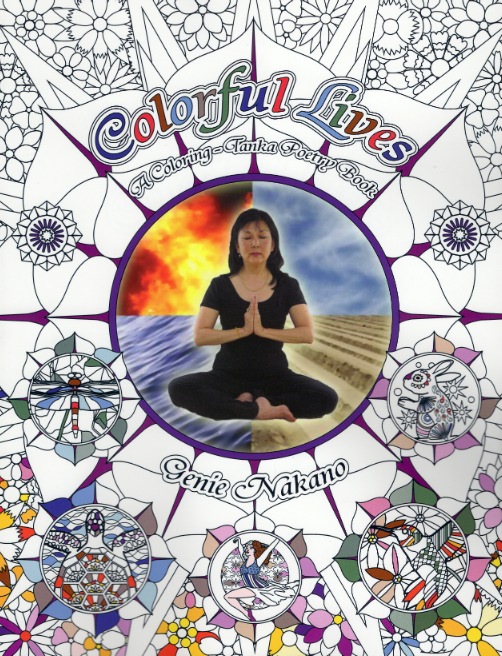
SoCal poet/yoga instructor/tanka instructor Genie Nakano's newest volume of tanka, Colorful Lives: A Coloring-Tanka Poetry Book (© 2016 Chin Music Press, www.chinmusicpress.com), is an unique type of poetry book, in that it employs tanka strings, a combination of interlinking tanka, and it's a coloring book, with beautiful black and white illustrations by artist Alvin Takamori. The combination of poetry and visuals provides the reader with a multi-sensory experience, and with the added opportunity to color, gives the reader the tactile pleasure of absorbing the poetry and illustrations on a visceral level.
Nakano agreed to an interview, to discuss the process of crafting tanka, her newest collection, and her creative process. For those interested in learning how to write tanka, Nakano facilitates a monthly workshop, Tanoshi Tanka Class, on the third Thursday of the month (this month, July 20, 2017), at the Gardena Valley Japanese Cultural Institute, 1964 W. 162nd Street, Room 214, 7-9 pm. (Cost $5, $3 if you become a Tomonokai member). Contact Genie at 310-644-1186, email: genieyogini AT gmail dot com.
1.
What drew you to writing short form poetry, particularly tanka?
GN: Tanka
is very personal, emotional, often times of a confessional nature. A
Kaleidoscope of emotions can be expressed in five lines. A whole
story captured in 19 – 31 syllables or sounds. A friend gave me a
copy of a tanka journal—Ribbons. I raced through the journal,
reread and wanted more. The impact was direct. They were like Zen
gardens where only the essence remains. Then immediately pages of
tanka poured out of me. From then on I was hooked and obsessed with
writing and learning tanka. Soon after, Ribbons published the first
tanka I wrote.
This is #1:
my unborn
clung
to a fallopian tube
no
one knows
of
the hidden scar
where
life was sliced out of me
2.
What made you decide to combine two art forms - visual and written –
into your latest collection?
GN: Prior
to working with Alvin, I included dance, photography and music in my
presentations. I was a dancer for most of my life and collaborating
with musicians and other dancers is the creative process. Where as
many of my tanka are confessional or verge on Kyoka style. In Colorful Lives, so much of the imagery, hummingbirds, flowers,
waterfalls call out for color and illustrations.
sunlight
is what flowers turn to
Sensei
says
we
are all flowers
with
colorful short lives “Colorful Lives”, page 43
if
I were
to
write a play
about
my life
it
would be
a
comedy of errors (Kyoka style) Genie Nakano
3.
What was it like to see poems translated into a visual medium? What
advice would you give to ensure a successful outcome?
GN: It
was very exciting when Alvin showed me his first images of Colorful
Lives. I remember smiling and laughing. We hadn’t planned to
make a coloring book. But when I saw how Alvin transformed "A
New Year" into an image it immediately said —coloring book. I
was almost apologetic when asking him to make the images into a
coloring book, all his detailed work had to be converted into
coloring book form.
However,
we are both very happy with the outcome.
I
knew of Alvin’s’ work because we both work and volunteer at the
Gardena Valley Japanese Cultural Institute. So I felt very secure
knowing Alvin was responsible and reliable. I handed him about fifty
tanka series and asked that he choose the ones that inspired him. From then on Alvin followed his own vision. We met over breakfast
from time to time to discuss our progress. It was a wonderful
surprise to see all his beautiful images.
My
advice--know your collaborators work and work relations. Communicate,
bounce ideas and take your time. They are the illustrator and you
are the poet.
4.
Every poet has a different writing process: some write in their
heads until the poems come out finished, others write down fragments
and then weave them together, and many will labor over a poem like a
marble sculpture. What is your writing process of writing like?
GN: I
feel my best tanka are the ones that flow straight from the heart to
the paper or screen. My editing consists of shaving off words or
rearranging the order/sequencing. Over the years I’ve been
experimenting with the many tanka forms such as tanka response, tanka
strings, tanka prose. Currently I'm experimenting with the
3,5,3,5,5 rhythm. It makes, as Amelia says “the tanka sing”. The
form is compact, notably asymmetrical and gets down to the core—right
here, right now.
My
tanka mentor, Amelia Fielden, said, "Quantity, over time, makes quality." I
took it literally and at the beginning I wrote constantly. I carried
a notebook everywhere jotting down observational shasei tanka. My
favorite shasei poet was Takuboku. I practiced emulating his style.
I didn’t want to judge myself—just write. I developed tanka
muscle.
night
in
Asakusa
my
loneliness
mingles
with
the
crowds Takuboku, 1885-1921
5.
How has your background as a dancer and yoga instructor influenced
you as a poet?
GN: My
dance background was such an integral part of my being. Too bad I had
a hip replacement because I’d be dancing more. Dance requires
discipline, learning the fundamentals. This is how I approached
learning tanka. I wrote everyday and developed tanka muscles. Yoga
integrates tanka into meditative act. Tanka settles me and often
summarizes my day. The sound, rhythm the dance of tanka shapes my
tanka.
6.
The tanka strings in Colorful Lives, function, on the
surface, like a series of intimate confidences between the poet and
reader. There’s a deeper level beneath the first where the reader
finds herself wanting more, as in wondering what comes “after”
each poem’s end. Would you agree/not agree, and if so/why/not?
GN: Yes,
many of the tanka in Colorful Lives are prompted by meditation. Some
are conversations with myself, as in “Letting Go”, “Straight
Ahead”. By talking to myself, I hope some sort of transformation
will happen. I so much want children to love tanka, so some tanka are
conversations with children. “Shush”, is a lullaby for a child ,and
my insomniac mind. "Shushhh", is used in Chi Gong as a healing sound
and a sound to calm our fears. Some tanka offer
resolutions—“endings”, and some bring more
“questions”—beginnings. I hope both were offered.
shaking
as
I cross the bridge
I
look
straight
ahead, Colorful Lives, page 43
7.
Tanka, or waka, enjoyed a time of prosperity in ancient Japan, with
the central themes being love/romance/nature. It became popular
again in the late 19th/early 20th centuries,
where it was then considered an almost “everyman” form of poetry,
often used for political and propaganda purposes. In modern-day
Japan, tanka has become a popular form of poetry in Western Culture.
Where do you see the future of tanka going next?
GN: I
think tanka is just beginning here in the United States. From my
experience, many people are familiar with haiku ,but not tanka. Jack
Kerouac, Alan Ginsberg helped the wave of haiku. However, tanka has
not yet reached that momentum. I hope to see tanka studied in the
schools and universities. Tanka educates you about yourself. Tanka
response offers exciting ways of interacting. The virtues of tanka
are endless. I see tanka in USA going in many directions. We have
over 1,500 years of history from Japan to pull from. In our
diversity, I see minimalist tanka taking shape, the lyrical, longing
“Golden Age” style tanka flourishes, kyoka is on the rise, and
there is plenty of room in the frontier.
However, I hope the rhythm, or waka, of tanka is not lost. As a dancer, the rhythm of tanka lured
me. I was pleased and surprised that there a good number of people
who attended the Tanoshi tanka workshop held at Beyond Baroque. Let’s
keep that movement going.
8.
Some authors say they feel a sense of regret/loss upon the
publication of a new book. How do you regard this assertion upon the
publication of Colorful Lives?
GN: No,
I don’t feel a sense of regret. I look forward to publishing
another book of tanka. I would like to create another book of kyoka
and also meditative themes with doodles and mandalas.
9.
What advice would you give to poets who would like to start writing
haiku or tanka, as far as who to read, what rules to/not adhere to?
GN: Start
with the classics. Learn the history of tanka. It is fascinating.
Read ancient tanka and go down the historical path to present. Read
the lives of Japan’s tanka poets—what they went through—their
passions—some went to prison for their beliefs. Their lives are
inspirational.
As
I said, I am a stickler for rhythm. I hope the short, long, short,
long, long pattern—no less then 19 sounds or longer than 31 is
upheld. Traditionally, tanka builds and the last two lines should be
powerful. However, there are always exceptions. Ultimately, its
about content and sound. I believe poetry should be spoken to get the
full impact.
My
recommended books, journals and tanka poets, are: Akiko
Yosano, Tangled Hair, Ono no Komachi and Izumi Shikibu, TheInk Dark Moon, Takuboku: Poems to Eat, Modern JapaneseTanka, edited by Makoto Ueda. AmeliaFielden, an Australian poet and translator, has written many tanka
books. Conversations in Tanka is a great book for Tanka Response.
Journals:
Gusts,
editor Kozue Uzawa
Ribbons,
from the Tanka Society of America.
10.
What insights do you hope our readers will gain from Colorful
Lives?
GN: Because
of the triple nature of Colorful Lives—words, visuals and the
interaction of coloring in the graphics, insight is
multi-dimensional. Even children can respond to the tanka by
visuals and coloring in “The undefined spaces require readers to
fill in the unspoken with their imaginations”. . David Lanaoue
professor of English. I hope my love for this earth, nature, animals
and people can be felt. I offer my words, and hope they evoke
insight, humor and wonder into my readers. Each person has their own
interpretation from the ground they stand on.