Sunday, October 6, 2013

Alex S. Johnson's The Matador of Mirrors


Today, there’s almost no one who can write as well, and at the same time, prolifically as author Alex S. Johnson (The Doom Hippies, Black Tongues of the Illuminati). Daily, anyone can log onto Facebook and find two or three new posts of Johnson's scarily brilliant poetry or prose. If a reader desires to become more acquainted with Johnson's work, then his newest chapbook, The Matador of Mirrors (©  2013 Lucid Play Publishing), is a great place to start.

Matador delivers some of the best of Johnson's writing in a series of shorts (poetry and flash fiction), that will leave the reader, who may think she's prepared, dead flat on her proverbial back from the onslaught of Johnson's genius. Johnson lives in Bizarro World (he's listed as a top writer of bizarro fiction on Wikipedia), and he comes by his writing gift naturally (he's the son of Steven Johnson, noted artist and “Accidental Futurist). If one is to read bizarro fiction and poetry, especially Johnson's, then, one must come into the process with two things: an appreciation for the absurd, and an openness to the gorgeous variations of Johnson's vision. Matador opens with a short prose poem, “Body Art,” a paean to what could be described as a bizarro goddess – beautiful, shocking, humorous, and primal:

Her body was a journey. She became an exploration of golden temples, smiling pagodas, oracular energy. She sipped at the narratives that snaked up from the chinks in the stone. They cooled her throat, only she wanted more: diamonds that became wine, gems of all sizes, shapes and colors that spoke the language of hone. Singing draughts of perfume cleansed the air. A stock of recyclable babies clad in graveskin. The world riddled with tiny marble wounds that spat out forests where the tips of every branch yielded clockwork dynasties.

Matador, like its title promises, leads the reader on a rapid turn-on-the-dime dance through the doors of Johnson's perception: “Imaginary Criminals,” briefly drops the reader into a world of creepy surrealist film noir; “Today She is French,” explores a day in the life of a young woman whose imagination and casual donning of pop culture personas is her only escape from a dystopian home life; and “Matador of Mirrors,” beautiful and peripherally continues a journey through the constantly shifting dreamscape introduced in “Body Art.”

My only regret about Matador is that, at the end, I want more; more absurdity, weird beauty, and more time to immerse myself in Johnson's universe. The Matador of Mirrors is going on my permanent shelf, to be brought out again when I need a creative kick in the pants, and, more importantly, when I desire to read a truly great piece of literature.

The Matador of Mirrors, Alex S. Johnson, ©  2013 Lucid Play Publishing, (http://lucidplaypublishing.weebly.com/the-matador-of-mirrors.html), 30 pages, $8.00 + shipping when ordered through the publisher website.

"Body Art" content © 2013 Alex S. Johnson
Review content © 2013 marie lecrivain

Saturday, August 3, 2013

Larry Colker's Amnesia and Wings


O misbegotten fool
in pool of inklings
things cannot be clear... - “Lyric”/Amnesia and Wings


Above is a gorgeous snippet of poetry from Larry Colker’s debut collection, Amnesia and Wings (© 2013 Tebot Bach Press). Most first collections are heavily laden with verse. To be honest, this handicap can turn off a reader to a poet’s future work. The opposite is true with Colker’s collection: 32 poems bound into one slim volume - which, in point of fact, turns out to be the perfect amount of poetry.

Colker, a careful bard, writes with the artful restraint of a man who's lived most of his life walking a fine line between the mundane and waking worlds. Like an alchemist, Colker has distilled his life experiences (mostly about love, and up to this point), into a series of beautifully written poems that are a genuine pleasure for the reader in which to immerse herself. Colker’s not afraid of linguistic gymnastics; quite a few of his poems could be put down to workshop exercises, but a touch of self-deprecating humor saves the day, as in the piece “Lunch Poem”:


Today I’m eating Brazilian,
three kinds of meat on a
skewer.


Big knife!


The woman I nearly started an affair with
was - is -
Brazilian.


Big knife!


She tasted like this fried banana,
sugary, fragrant, yielding,
slick.


Big knife!


I tried to give my marriage another chance;
kissed artistic, sexy, portugues-inflected Amalia
good-bye.


Big knife!


While the theme of love dominates Amnesia and Wings, Colker also explores other avenues; family (“Projector”), mythical archetypes (“Eros in the Heartland,” “Legend”), and the growing sense of one’s own morality (“China,” “Crossing Over (Exhibit #204)”). Though Colker is careful, he's not sparing of himself or his subjects. Each poem is bracketed by the conviction of a man who has no qualms in sharing and accepting the variegated, truthful totality of a fascinating and well-lived life. Few contemporary poets are capable of making that commitment to themselves or to their work.

Amnesia and Wings deserves a place on every poet’s bookshelf.


Amnesia and Wings,  © 2013 Larry Colker, Tebot Bach Press, ISBN 978-1-893670-6-31, 45 pages, $16.


Article content © 2013 marie lecrivain
poetic content © 2013 Larry Colker

Monday, July 22, 2013

Michelle Angelini aka Rina Rose's Between the Silence and Sound: Poetry and Photography of Rina Rose


   Local L.A. poet Michelle Angelini's aka Rina Rose's debut chapbook Between the Silence and Sound: Poetry and Photography of Rina Rose (copyright 2013 Rina Rose Publications), offers a fun mix of words and images that are locally inspired, interesting and accessible.

   Angelini, an East Hollywood resident, writes from the heart with skill and a touch of humility. There's no hubris in Angelini's poems, but there's warmth, humor and compassion. There are poems about past loves (“Unchanged Minds,” and “Past Magic”); passages that reveal the humanity in those society refuses to acknowledge, aka the homeless ("Too Many Sunrises”); elegies dedicated to the loss of youth to war (“The Last Plane Out of Persia”), and poems that explore inner and external archetypes ('Winged Epistle,” and “When She Smiles”). A third of the book is filled with poems and images dedicated to Angelini's unabashed love of the animal kingdom, in particular, her cat Sasha, but if Mark Twain extolled the virtues of felines and still remains one of America's most beloved authors, so can Angelini.

    The only downside, (and it's a slight one), are the numerous nature photos in Between the Silence and Sound, which are grouped in batches of three. The photos are lovely, but they so small that the colors and the details are obscured; the reader may find these images to be a distraction, however, the poetry more than makes up for it. What I like best about Between the Silence and Sound is that Angelini refused to hold back on showcasing both of her artistic loves - poetry and photography - which is a trend I hope will continue in the realm of DIY publishing. I look forward to Angelini's next book.


    Between Silence and Sound: Poetry and Photography of Rina Rose, Michelle Angelini aka Rina Rose, (copyright 2013 Rina Rose Publications), 978-1490437552 , 44 pages, $10.

© 2013 marie lecrivain

Saturday, June 15, 2013

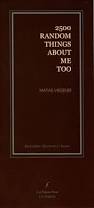
Matias Viegener's 2500 Random Things About Me Too


Have you noticed how fashionable randomness is right now? Random is the new black. - 2,500 Random Things About Me Too


    The virtual documentation of our lives has become so commonplace (and, still continues, even while the NSA rifles through American citizens’ personal data) that the majority of people, including myself, almost don’t remember WHAT the world was like without social networks. Sadly, most of what is written into the ether is ignored. The truth is that the average person can’t cope with the onslaught of compulsive, collective thought. However, for artists like Matias Viegener, interacting with Facebook on a daily basis with a conscious artistic goal paid off with literary results: The memoir, 2500 Random Things About Me Too (copyright 2012 Les Figues Press).


   Viegener, a writer, and instructor at CalArts, decided to write 25 posts a day on Facebook - random things - until he reached 2,500 posts (I believe he reached more than that, but, for the purposes of the book, and this review, it’s officially “2,500”). In reality, this isn’t a big deal. Millions of FB members clog the Internet every day with meaningless drivel. The difference is this that Viegener created a highly personal memoir by not-so-randomly reconstructing the varied facets of his life.
   
   2500 opens with, People think I am American but inside I am foreign. (post 1, ch i); a great opening line for a memoir, but, one that’s not supposed to be intentional. Fortunately, the human brain is designed to recognize and sort through patterns of thought, and this is reflected in each chapter, though, with the non-sequential chapter numbers, one may be led to believe otherwise.
    
    Viegener reveals parts of himself that can’t help but tie together; real-time, intimate observations of his dying canine companion Peggy (I intend to let go of Peggy when the time is right. I think she still has a few more weeks. I’m mourning her a little now, while she’s still here to comfort me. She seems not to be suffering, just sort of evaporating. - post 7, ch liii);  pithy, in-the-moment views on art (Some people just pose in front of art. They want to be seen in its company - post 13, ch. ixxxix); sexual orientation (It is interesting that we don’t seem to think of homosexuality as innocent. - post 25, ch lxvii); an anecdotal history of his immigrant parents (My parents had an appreciation for certain things about American culture. Wooden ducks, decoys. Moonshine jugs. Collapsed barns. These must all sound like the cliches of Americana, but through my mother I came to see them as very exotic. - v. 6, ch xxviii); and, the impact of the death of his mother (I’d destroy every conceptual art piece on earth to spend an afternoon with my mother again.” - post 17, ch xci).


    Viegener spends a great deal of time consciously reflecting on the process of keeping his posts “random,” as well as the the effect his posts have on his FB friends (Sometimes people’s comments on my random things are better than my random things. - post 3, ch xxxiv). On the surface, the overall effect of 2500 could be construed as narcissistic, another subject which Viegener opines, however, that is not the case. Viegener has a highly disciplined and well-organized mind, which is reflected in his succinct and engrossing conversational style, and, in the spiral patterns of his narrative. He can’t help but go back to the most important topics - the foundations of his personal history, and those immediate things/incidents which eventually become woven into the tapestry of who Viegener has become/is becoming.  


    2500 Random Things About Me Too serves to the reader an invaluable lesson: in revealing ourselves, even in the virtual world, we cannot escape, and, we must come to terms with, the totality of who each of us “is,” especially under our own scrutiny.


2500 Random Things About Me Too, Matias Viegener, (copyright 2012 Les Figues Press, www.lesfigues.com), 978-934254-35-6, 255 pages, $15.00


book content ©  2012 Matias Viegener
article content ©  2013 Marie Lecrivain

Thursday, June 13, 2013

Emilio and Enrique - Gonzalez Avenue poets' The Problem with Oxnard


The Problem with Oxnard, a small (literally) chapbook of poems by Emilio and Enrique – Gonzalez Avenue poets (copyright 2012 Emilio and Enrique - Gonzalez Ave poets - layout produced by Brass Tacks), presents a conundrum of sorts. Google the phrase “the problem with Oxnard,” and in the top three Internet searches is the comment “a small city with big problems.” Try to google the names of Emilio and Enrique, and one gets nothing... and, no response to my email query for information about this neat little chapbook. So, with that in mind, here is my assessment.

    Manifestos can come in any form – big, small, bombastic, unassuming. The cover, an image of a strawberry (one of the Ventura County's more popular crops), with an insert of the title, is intriguing in its simplicity. Oxnard packs a punch, with no apologies. The introduction explains, as many people are wont to forget, that Oxnard used to be part of what was once Mexico (or, Azteca, according to the authors). Anyone who has driven up the California Coast, or Route 126, will no doubt remember that the landscape is populated with fruit stands, and, in the warmer part of the year, with migrant workers who harvest the produce. The poets, whose roots go deep into the soil of Oxnard itself, invite the reader to experience the dichotomy that is Oxnard, with their straightforward and 'staccato' verse.

Oxnard contains seven poems, which seems a bit on the skimpy side, however, each little poem captures accurately, and beautifully, the sinister weirdness of living in a place millions obliviously travel through every year. The first poem, “Detour Use Gonzalez,” tells the story of life's goals being detoured, by circumstance, class oppression, and diminished expectations. From there, the next few poems “Often,Thirsty,” “The Migrants,” “Over the Land,” and “Land of Opportunity,” spell out the alienation, and, the discrimination, migrant workers, and their children, have faced/still face in land that once belonged to their ancestors (from “Over the Land:):


As we look out
Over the land, this land -
the land we manage
and harvest with our hands
we know it is not our earth
but that of men, with
strange children, who live
far away – their names
are on the paper that pays us -
but they never come
to these bountiful, dirty
beautiful acres we work
and have for years where we
hear our brown children cry
for beans and rice... never
the strawberries, kale
asparagus and flowers we pick -
and send to unknown tribes-
but the meager food of
an honest people who
are simply seeking
a better day.

    The overall tone of the poems in Oxnard are strong, and, infused with the dignity of the migrant workers the authors extol; that's what saves this little gem of a book from the falling into the ponderous whirlpool of angry political poetry. The other two poems “Oxnard,” and “Stars,” are as close to pastoral as I believe the poets can wax about the strange beauty of their home (from “Stars”):


The same star
on one side
of the sky -
then another;
emerald with
blue glints
over Oxnard -
appearing red
and orange
above the unlit
darkness of Highway 1 -
a scattering of them
to the south, to match
Palos Verdes; jumble
of jewels... confusing
how these myriad
points of light
owe so little
to our world.


    Here is the fun part: where to pick up a copy of The Problem with Oxnard. I emailed Brass Tacks Press. One of their editors/publishers answered my questions, and, was nice enough to let me know that Oxnard is self-published; as in, it's not officially part of the Brass Tacks Press catalog of books (ps: they have some awesome titles!). Brass Tacks lent their “aegis,” (production expertise), to the authors of Oxnard. Since Emilio and Enrique don't seem to check their email very often, the only place I can tell you to find a copy of Oxnard is at Skylight Books (1818 N. Vermont Ave, Los Angeles, 90027), in the Art/Zine/Graphic Novel section of their store.

    The Problem With Oxnard successfully documents what most Californians prefer to forget; the sins of history cannot be concealed by the sweet smell of (agricultural/retail) commerce. Poets like Emilio and Enrique, will always remember, and, that is necessary.


  The Problem With Oxnard, (copyright Emilio and Enrique, Gonzalez Avenue poets, oxnardpoets@gmail.com - layout done Brass Tacks Press_Mini Brass Tacks), 18 pages, $3, available at Skylight Books, http://www.skylightbooks.com .


poetry content © 2013 Emilio and Enrique - Gonzalez Avenue poets

article content © 2013 Marie Lecrivain

Thursday, May 30, 2013

Shaindel Beers' The Children's War and Other Poems


     This is the end of the innocence – Don Henley

     Part of the poet's “job” description is to record historical content – and Shaindel Beers' The Children's War and Other Poems (copyright 2013 Salt Publishing), chronicles the loss of innocence through war's violent variations: internal/external genocide, person against society, person against themselves.

     The Children's War, as its title promises, provides the reader with a series of brutal ekphrastic poems that successfully extrapolate the annihilation of innocence through children's eyes, either through drawings/paintings made by children who've survived war, or photographs taken of child refugees. As no one, (at least a normal person), reacts to a child's pain without a mixture of anger and discomfort, the first half of The Children's War is almost impossible to read. Beers throws down the gauntlet: though the language is spare - like a child's - the feelings, the emotions, the empathy stirred within the heart of the reader - are not. There is a primal, raw power in Beers' poems, which can't be circumvented; the reader is put on the spot as a child's pain and loss take center stage, as in the poem “After Martija's Watercolor, Croatia”:

There are things that can happen that you can't draw.
A soldier ripping off the baby's diaper and slamming him
in tot he wall because it will be easier if the baby
cannot cry. Your mother without a head. Your paint splotches.
Green and blue are peaceful. That was before.
Now, everything is red. The red mixed with the green
becomes a sickening brown. The brown that covered
your thighs when a soldier was done with you.

     The second half of the book “Other Poems,” continue on with the same theme, but on a more universal scale; loss of innocence through love betrayed (“Love Poem for the Other Woman'); the discovery that one's parents are human after all (“Origins”); the loss of childhood talismans at the hands of bullies (“Ode to Plastic Ball and Bat”), and the loss of one's passion (“The Last Ballet Class Before the Operation). Beers narrative tone lightens – somewhat - in the second half of The Children's War, yet, the poems are just as compelling, and unforgettable.

     Clearly, The Children's War and Other Poems is NOT for everyone. It's for the brave reader, one to match the fortitude of a poet like Beers', who offers, unflinchingly, a reminder that while the world we live in is an ugly place, there is still great beauty to be found in the depths of sorrow, honesty, and, in never forgetting our humanity.

The Children's War and Other Poems, copyright 2013 Shaindel Beers, Salt Publishing, www.saltpublishing.com, ISBN 978-1-84471-930-3, 67 pages, $15.26

(poem/cover art © 2013 Shaindel Beers/Salt Publishing)

(article content © 2013 Marie Lecrivain)

Monday, March 11, 2013

Every Day is An Act of Resistance: Selected Poems by Carol Tarlen


     Every Day is an Act of Resistance: Selected Poems by Carol Tarlen, edited by David Joseph and Julia Stein (copyright 2012 Mongrel Empire Press), is a fitting tribute, and homage to Tarlen; poet, mother, activist, and compassionate human being.

     In Every Day, each poem is infused with the daily life of Tarlen, and vice versa. Tarlen was a poet who lived with her shields down, and, in the tradition of Blake and Whitman, breathed poetry as easily as air; her poems are full of vitality, and, decidedly non-magical, as one would expect from a working-class poet. However, there is a delicacy to her work, a sensitive strength, which takes Tarlen's poems out of the category of “working-class,” which may be, along with her background, puts her in class by herself. Tarlen's poems evoke the beauty of a wrought-iron fence: strong, detailed, and, starkly exquisite, as in the poem, “To a Young Dancer”:

You cant bend your knees,
So you cry at night, while
I pound language from a
machine. “I'm sorry”
is an empty sound, not worth
legs gone mute. In this

Chinese year of the horse,
we don't speak of justice,
or that you been named
snake. The doctor says
Quit the dance, but I'm your
Mother, and I say, CRAWL,

Light circling your new skin,
as you slide to center stage.

     Tarlen, a Bay Area poet, was not able to achieve the level of success that most of her peers. Co-editor Julia Stein, who wrote the moving forward for Every Day, described Tarlen as a “North Beach Emily Dickenson.” Tarlen was widely published in literary magazines and anthologies, but was not able to secure a publisher to put out a full-length collection of poetry during her lifetime. That is where the difference ends. Poetry publishers, are no different than other publishers who have to think in terms of dollars and cents, but, more than likely, were intimidated by the frankness of subject matter of Tarlen's work. Seriously, who wants to read about a woman's struggle to come to terms with violence and violation, as in the powerful poem “Arguments With a Would-be Rapist?” Or, who wants to be reminded of the struggle to make ends meet as in the poem, “Welfare Rights,” or, be gently admonished by Tarlen into remembering that every person, no matter what their circumstances, is infused with the spark of the divine, as in the poem “As an Angel Glimpsed by Blake”:

Standing near the doorway of a steel-
encased office building, the man
in the worn, black suit
wipes the soil from his frayed, white
starched cuffs and waits
for his son to enter, eyes lowered,
as the man too, lowers his eyes.
This is the best he has,
the poverty he wears, his empty hands
a gift of shame for a son
who looks away.

I see the old man
in a darkened theater,
an image superimposed on scenes
of a filmed revolution,
slipping between shadows that fall
on slogan-plastered walls.
He is my vision, my DNA chain;
I circle my wrists with his hunger
that shimmers beneath my skin
translucent like a bleached jellyfish
on oil-slicked sand.

     The answer to the above questions is that I would, as well as others who can look beyond the appellate “working-class,” will appreciate the depth of feeling, and power of Tarlen's work.

Every Day is an Act of Resistance: Selected Poems by Carol Tarlen, (copyright 2012 Mongrel Empire Press, www.mongrelempire.org) edited by David Joseph and Julia Stein, ISBN 978-98330529-3, 63 pages, $14.

 © article content 2013 marie lecrivain
 © poems 2012 Carol Tarlen