Nothing as it was is how it now goes - Peggy Dobreer/Forbidden Plums
It’s an almost accepted global truth that our lives have been divided into “the before times,” and who we are all now, which, due to the global covid 19 pandemic, have been radically altered, in many cases, to the point where we don’t recognise ourselves.
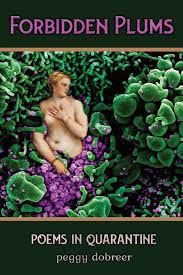
The process is called alchemy, though that’s not widely discussed (it needs to be). Quite a few poets of note took advantage of this period of seeming inactivity to explore the radical change, within, and outside of themselves, as did Peggy Dobreer, author In the Lake of Your Bones, (© 2012 Moon Tide Press), and Drop and Dazzle ( © 2018 Moon Tide Press). However, Dobreer did it better, and during 40 days of lockdown, created her chapbook Forbidden Plums: Poems in Quarantine (© 2021, Glass Lyre Press).
Forbidden Poems is divided into three parts: Chapter 1: The Shock of Exception, Entries: Untoward Symmetry, and Chapter 2: Oscillant Entrainment. The opening poem “Tine & “Promise”, describes the process of an artisan casting a shape, in this case, a metal ring, as it goes into the crucible, and is formed by fire. This sets the tone for Forbidden Plums, as the reader is brought into the shocking change that takes place in the poet’s conscience:
When the kiln is fired and
flask set dead center. When
heat rounds the silken core
and in those first few hours
the mold does ooze and
grimace, roasting away from
the unforgiving glare, we sneak
a look and waves peel across
the studio. Green folds into
carbon black on steel, armature,
burst and sizzle, bites of time,
hiss and song of industry.
Chapter 1 contains more poems that delve deep into the inner world we all inhabit, though Dobreer’s is more colorful, and elegantly juxtaposed than most, with the the language of covid infused into her poetry:
Com-uppance is now required for
compliance, mandatory testing is reliance.
No one left standing will be left standing. (“Crossings”)
And,
This is a virus I won’t survive one more time.
But I wonder why I don’t just play my last hand
and let myself go out like that… with all my
missed marks bundled into one last straw. (“Phantom in Sight'').
The second section, Entries: Untoward Symmetry, captures a process most creatives don’t talk about, except recently, in social media; the process of memories being used as a distractive focus while transitioning through a deep and fundamental artistic change. In this case, it’s the poet examining herself in relation to others, or her different selves, through the long lens of memory, to rediscover those things lost along the way:
I don’t know where I lost the way of
extending invitations. I stopped
fixing curried lamb, lighting wicks.
No longer selected sparkling wines,
taking time and pomp to pour at the
table (“Inquisition”)
Or a discovery of new facets within the poet’s self:
I love bubbles and
bargains, and the color of apricots. I’m not
fancy and don’t even mention children.
Some things go simple and long as you
knit. (“Simulation”)
The final section, Oscillant Entrainment, chronicles how the poet works toward aligning exterior circumstance to the journey within herself. This is where Dobreer shines best, employing her years of expertise in the fields of dance, body movement, and performance, to distill a beautifully crafted series of poems that examine, in the way that Peter Abelard’s Sic et Non did centuries ago, the final values of Yes and No, Why and Why Not, and where that will take her next, as in the poem “Fool’s Gold in the Eyes of Love”:
This is my body, invisible acre, moon lander,
cold star of stars coming out of this dark
Corona, thing black depth of coal shaft, kettle
bottom thunker, one leaf hewn and shade
provoking, provider, now boom lowered,
calling our courage back. Flesh and chant,
rutilated breath, delicate provider, insider
and long left out.
When looking back at the last three years of what’s been a rude awakening for every person on the planet, it’s reassuring to know that someone as wise, and courageous as Dobreer, took it upon herself to provide not just a chronicle of surviving the early days of the pandemic, but a personal hero’s journey that can be used as a framework by others who have yet to do so. I’ll definitely keep this volume with me, as a touchstone and reminder we all have the gifts within us to change, to accept that change, and to become better for it.
Forbidden Plums, © 2021 Glass Lyre Press, Peggy Dobreer, ISBN 978-1-941783-76-4, $16 (US).
© 2022 marie c lecrivain

