


Bio: Ann Privateer is a poet, artist, and photographer. Some of her recent work has appeared in Third Wednesday, and Entering, to name a few.
Bio: Ann Privateer is a poet, artist, and photographer. Some of her recent work has appeared in Third Wednesday, and Entering, to name a few.
Volunteer
I left this poem behind in the prison where I
volunteer once a month. I couldn’t bear to take
it with me. I never finished it. I never wrote it
down. Early that morning, I set up the CD recorder
to capture the prisoners’ voices. The women read
storybooks into the microphone to their child or
grandchild (or perhaps someone else’s). We
encourage the prisoners to add personal messages:
I miss you, I will be home soon (even if it isn’t true).
Later on, the CD and the book are mailed. We are told
during training not to talk with the inmates. It could lead
to manipulation and favors. Often, though, before I can
stop it, someone tells me about her crime, or the months
or years till she gets released. When the first woman
entered the room that day, she was petite, timid ─ I thought
my poem could be about her – her mistake, how she rose
above her situation. But she said very little. She did share
a family photo: her daughter, granddaughter (who would
get the book), her 95 year old parents. I pressed record.
Her voice was warm and gentle, as if she were seated in
her picture, not this cinderblock classroom where guards
patrolled outside. While we waited for the CD to eject,
I thought she might say more. Here, I expected my
poem could turn melancholy, bittersweet, remorseful.
But she stayed silent. Afterwards, the social worker
told me about the ex-boyfriend she shot and the
new girlfriend she stabbed ─ so much blood. She’d only
been there two of the seventy years she would serve.
© 2022 Nancy Lubarsky

Bio: Nancy Lubarsky has been an educator for over 35 years. A retired school superintendent, she holds a Doctorate in English Education from Rutgers University. Nancy has been published in various journals, including Edison Literary Review, Lips, Poetry Nook, Poetica, Tiferet, Exit 13, Stillwater Review, Howl of Sorrow Anthology, Paterson Literary Review, and US1 Worksheets. She received honorable mention in the 2014 and 2016 Allen Ginsberg Poetry Awards, and Editor’s Choice in 2017. She has also been nominated twice for the Pushcart prize. She is the author of two books: Tattoos (Finishing Line Press) and The Only Proof (Kelsay Press).
She has been in the burning frost of the highest peak
to unlock the deepest secret and to release the bittersweet
sorrow. In her upward fall, she told the downright evilness,
'I want nothing more and never again. ' She hung those words
in that eloquent quietness and the quietness oscillated in
the air. She found its own sense and the opposite. The words
and the memory blackouts were like the stars and the holes. In
a spiritual freezer burning, she reached the insomniac
dreams of her destiny and the deceptiveness of her distorted
fate. A new time made them grow into dormant feelings and
vice versa much more than certain old lyrics could turn into
pure music sounds to be lyric songs again. Her silent scream
slipped into a cosmic echo through the gate of that magic
realism. Became deafening stillness forever. Fairly obviously,
the down climbing evilness replied, 'I want nothing
more and never again, nothing more and never again.'
© 2022 Marieta Maglas

The Oddville Press, Sybaritic Press, Prolific Press, Silver Birch Press, Ardus Publications, and some others published the poems of Marieta Maglas in anthologies like Near Kin: A Collection of Words and Art Inspired by Octavia Estelle Butler, The Oddville Press Summer 2018, Nancy Drew Anthology: Writing&Art Featuring Everybody's Favorite Female Sleuth, Three Line Poetry, Tanka Journal, The Aquillrelle Wall of Poetry, edited by Yossi Faybish, who edited, also, her poetry book, Cubic Words. She is a co-author for A Divine Madness: An Anthology of Modern Love Poetry, for Enchanted- Love Poems and Abstract Art, and some other anthologies.
We are all earth’s children
all we need is air &
spring
ocean is hectic possessing land
brazenly open to a long haul
being a human is to be remembered
by,
hostess of breadth
reborn in nature
we are here beyond
this earthly life
waving at our ancestors
needing them not to waver
& who will we greet
without our past
to stand still in arms reach
of a period so marvelous that it rejoices
© 2022 Ann Huang

Ann Huang is a multilingual Chinese American film director, poet, visual artist, writer, and producer. Huang's poem-film series Ann Huang Presents echoes metaphysical and multiverse themes such as life and death as well as social ills of the man’s world perceived by the female gaze. They are marked by broad philosophical and spiritual overtures such as the collective unconscious by Carl Jung. Her films have received numerous accolades in the film festival circuits and museum showcases.
I heard that in Savannah
Georgia during the time
of the yellow fever
many victims would slip
sussurating breaths rattling like leaves
into a coma when ill.
They appeared dead and gone
and so they were carted off
to the graveyard's manicured lawn
and interred living to the hill of the dead.
Subsequently, being buried alive
became a common fear.
To allay this sensible antipathy
bodies would be laid to rest with a bell
on their grave
and that bell was connected
to their fingers with a string.
A string to ring their finger
an Ariadne gift to suss
the maze of after-seeming-death.
If the person woke from their coma
and found themselves buried alive
they could move their finger
and ring the bell
restlessly ringing their fact of non-decease.
We are bell ringers, my friends.
We are not dead yet
and the strings attached
to our fingers
thrum
with fear but also hope.
We ring our bells
from the grave
that America has become.
We have hope.
We have been interred and comatose.
But we pull the string.
We ring, we ring.
My friends,
we are not dead yet.
© 2022 Annette Marie Smith

Annette Marie Smith is an American author and poet, writing beauty in a sometime wilderness. Her books of poetry and short stories have been featured in the reading room of Shakespeare and Company bookstore, Paris, France. She's been nominated for the Pushcart prize and her work has ridden the trains and buses of Minnesota as broadsides through a Mcknight Foundation grant. Published internationally, her work has been translated into Italian, Spanish, German, Cherokee script, and included in The Irish Poetry Reading Archive at UCD Library. She is currently working on her first literary novel. Find out more at annettemariesmith.com


Annette Marie Smith is an American author and poet, writing beauty in a sometime wilderness. Her books of poetry and short stories have been featured in the reading room of Shakespeare and Company bookstore, Paris, France. She's been nominated for the Pushcart prize and her work has ridden the trains and buses of Minnesota as broadsides through a Mcknight Foundation grant. Published internationally, her work has been translated into Italian, Spanish, German, Cherokee script, and included in The Irish Poetry Reading Archive at UCD Library. She is currently working on her first literary novel. Find out more at annettemariesmith.com
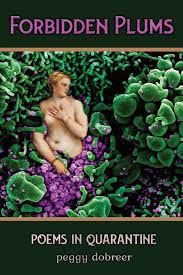
Nothing as it was is how it now goes - Peggy Dobreer/Forbidden Plums
It’s an almost accepted global truth that our lives have been divided into “the before times,” and who we are all now, which, due to the global covid 19 pandemic, have been radically altered, in many cases, to the point where we don’t recognise ourselves.
The process is called alchemy, though that’s not widely discussed (it needs to be). Quite a few poets of note took advantage of this period of seeming inactivity to explore the radical change, within, and outside of themselves, as did Peggy Dobreer, author In the Lake of Your Bones, (© 2012 Moon Tide Press), and Drop and Dazzle ( © 2018 Moon Tide Press). However, Dobreer did it better, and during 40 days of lockdown, created her chapbook Forbidden Plums: Poems in Quarantine (© 2021, Glass Lyre Press).
Forbidden Poems is divided into three parts: Chapter 1: The Shock of Exception, Entries: Untoward Symmetry, and Chapter 2: Oscillant Entrainment. The opening poem “Tine & “Promise”, describes the process of an artisan casting a shape, in this case, a metal ring, as it goes into the crucible, and is formed by fire. This sets the tone for Forbidden Plums, as the reader is brought into the shocking change that takes place in the poet’s conscience:
When the kiln is fired and
flask set dead center. When
heat rounds the silken core
and in those first few hours
the mold does ooze and
grimace, roasting away from
the unforgiving glare, we sneak
a look and waves peel across
the studio. Green folds into
carbon black on steel, armature,
burst and sizzle, bites of time,
hiss and song of industry.
Chapter 1 contains more poems that delve deep into the inner world we all inhabit, though Dobreer’s is more colorful, and elegantly juxtaposed than most, with the the language of covid infused into her poetry:
Com-uppance is now required for
compliance, mandatory testing is reliance.
No one left standing will be left standing. (“Crossings”)
And,
This is a virus I won’t survive one more time.
But I wonder why I don’t just play my last hand
and let myself go out like that… with all my
missed marks bundled into one last straw. (“Phantom in Sight'').
The second section, Entries: Untoward Symmetry, captures a process most creatives don’t talk about, except recently, in social media; the process of memories being used as a distractive focus while transitioning through a deep and fundamental artistic change. In this case, it’s the poet examining herself in relation to others, or her different selves, through the long lens of memory, to rediscover those things lost along the way:
I don’t know where I lost the way of
extending invitations. I stopped
fixing curried lamb, lighting wicks.
No longer selected sparkling wines,
taking time and pomp to pour at the
table (“Inquisition”)
Or a discovery of new facets within the poet’s self:
I love bubbles and
bargains, and the color of apricots. I’m not
fancy and don’t even mention children.
Some things go simple and long as you
knit. (“Simulation”)
The final section, Oscillant Entrainment, chronicles how the poet works toward aligning exterior circumstance to the journey within herself. This is where Dobreer shines best, employing her years of expertise in the fields of dance, body movement, and performance, to distill a beautifully crafted series of poems that examine, in the way that Peter Abelard’s Sic et Non did centuries ago, the final values of Yes and No, Why and Why Not, and where that will take her next, as in the poem “Fool’s Gold in the Eyes of Love”:
This is my body, invisible acre, moon lander,
cold star of stars coming out of this dark
Corona, thing black depth of coal shaft, kettle
bottom thunker, one leaf hewn and shade
provoking, provider, now boom lowered,
calling our courage back. Flesh and chant,
rutilated breath, delicate provider, insider
and long left out.
When looking back at the last three years of what’s been a rude awakening for every person on the planet, it’s reassuring to know that someone as wise, and courageous as Dobreer, took it upon herself to provide not just a chronicle of surviving the early days of the pandemic, but a personal hero’s journey that can be used as a framework by others who have yet to do so. I’ll definitely keep this volume with me, as a touchstone and reminder we all have the gifts within us to change, to accept that change, and to become better for it.
Forbidden Plums, © 2021 Glass Lyre Press, Peggy Dobreer, ISBN 978-1-941783-76-4, $16 (US).
© 2022 marie c lecrivain
