Saturday, June 15, 2013

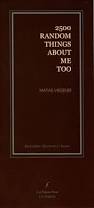
Matias Viegener's 2500 Random Things About Me Too


Have you noticed how fashionable randomness is right now? Random is the new black. - 2,500 Random Things About Me Too


    The virtual documentation of our lives has become so commonplace (and, still continues, even while the NSA rifles through American citizens’ personal data) that the majority of people, including myself, almost don’t remember WHAT the world was like without social networks. Sadly, most of what is written into the ether is ignored. The truth is that the average person can’t cope with the onslaught of compulsive, collective thought. However, for artists like Matias Viegener, interacting with Facebook on a daily basis with a conscious artistic goal paid off with literary results: The memoir, 2500 Random Things About Me Too (copyright 2012 Les Figues Press).


   Viegener, a writer, and instructor at CalArts, decided to write 25 posts a day on Facebook - random things - until he reached 2,500 posts (I believe he reached more than that, but, for the purposes of the book, and this review, it’s officially “2,500”). In reality, this isn’t a big deal. Millions of FB members clog the Internet every day with meaningless drivel. The difference is this that Viegener created a highly personal memoir by not-so-randomly reconstructing the varied facets of his life.
   
   2500 opens with, People think I am American but inside I am foreign. (post 1, ch i); a great opening line for a memoir, but, one that’s not supposed to be intentional. Fortunately, the human brain is designed to recognize and sort through patterns of thought, and this is reflected in each chapter, though, with the non-sequential chapter numbers, one may be led to believe otherwise.
    
    Viegener reveals parts of himself that can’t help but tie together; real-time, intimate observations of his dying canine companion Peggy (I intend to let go of Peggy when the time is right. I think she still has a few more weeks. I’m mourning her a little now, while she’s still here to comfort me. She seems not to be suffering, just sort of evaporating. - post 7, ch liii);  pithy, in-the-moment views on art (Some people just pose in front of art. They want to be seen in its company - post 13, ch. ixxxix); sexual orientation (It is interesting that we don’t seem to think of homosexuality as innocent. - post 25, ch lxvii); an anecdotal history of his immigrant parents (My parents had an appreciation for certain things about American culture. Wooden ducks, decoys. Moonshine jugs. Collapsed barns. These must all sound like the cliches of Americana, but through my mother I came to see them as very exotic. - v. 6, ch xxviii); and, the impact of the death of his mother (I’d destroy every conceptual art piece on earth to spend an afternoon with my mother again.” - post 17, ch xci).


    Viegener spends a great deal of time consciously reflecting on the process of keeping his posts “random,” as well as the the effect his posts have on his FB friends (Sometimes people’s comments on my random things are better than my random things. - post 3, ch xxxiv). On the surface, the overall effect of 2500 could be construed as narcissistic, another subject which Viegener opines, however, that is not the case. Viegener has a highly disciplined and well-organized mind, which is reflected in his succinct and engrossing conversational style, and, in the spiral patterns of his narrative. He can’t help but go back to the most important topics - the foundations of his personal history, and those immediate things/incidents which eventually become woven into the tapestry of who Viegener has become/is becoming.  


    2500 Random Things About Me Too serves to the reader an invaluable lesson: in revealing ourselves, even in the virtual world, we cannot escape, and, we must come to terms with, the totality of who each of us “is,” especially under our own scrutiny.


2500 Random Things About Me Too, Matias Viegener, (copyright 2012 Les Figues Press, www.lesfigues.com), 978-934254-35-6, 255 pages, $15.00


book content ©  2012 Matias Viegener
article content ©  2013 Marie Lecrivain

Thursday, June 13, 2013

Emilio and Enrique - Gonzalez Avenue poets' The Problem with Oxnard


The Problem with Oxnard, a small (literally) chapbook of poems by Emilio and Enrique – Gonzalez Avenue poets (copyright 2012 Emilio and Enrique - Gonzalez Ave poets - layout produced by Brass Tacks), presents a conundrum of sorts. Google the phrase “the problem with Oxnard,” and in the top three Internet searches is the comment “a small city with big problems.” Try to google the names of Emilio and Enrique, and one gets nothing... and, no response to my email query for information about this neat little chapbook. So, with that in mind, here is my assessment.

    Manifestos can come in any form – big, small, bombastic, unassuming. The cover, an image of a strawberry (one of the Ventura County's more popular crops), with an insert of the title, is intriguing in its simplicity. Oxnard packs a punch, with no apologies. The introduction explains, as many people are wont to forget, that Oxnard used to be part of what was once Mexico (or, Azteca, according to the authors). Anyone who has driven up the California Coast, or Route 126, will no doubt remember that the landscape is populated with fruit stands, and, in the warmer part of the year, with migrant workers who harvest the produce. The poets, whose roots go deep into the soil of Oxnard itself, invite the reader to experience the dichotomy that is Oxnard, with their straightforward and 'staccato' verse.

Oxnard contains seven poems, which seems a bit on the skimpy side, however, each little poem captures accurately, and beautifully, the sinister weirdness of living in a place millions obliviously travel through every year. The first poem, “Detour Use Gonzalez,” tells the story of life's goals being detoured, by circumstance, class oppression, and diminished expectations. From there, the next few poems “Often,Thirsty,” “The Migrants,” “Over the Land,” and “Land of Opportunity,” spell out the alienation, and, the discrimination, migrant workers, and their children, have faced/still face in land that once belonged to their ancestors (from “Over the Land:):


As we look out
Over the land, this land -
the land we manage
and harvest with our hands
we know it is not our earth
but that of men, with
strange children, who live
far away – their names
are on the paper that pays us -
but they never come
to these bountiful, dirty
beautiful acres we work
and have for years where we
hear our brown children cry
for beans and rice... never
the strawberries, kale
asparagus and flowers we pick -
and send to unknown tribes-
but the meager food of
an honest people who
are simply seeking
a better day.

    The overall tone of the poems in Oxnard are strong, and, infused with the dignity of the migrant workers the authors extol; that's what saves this little gem of a book from the falling into the ponderous whirlpool of angry political poetry. The other two poems “Oxnard,” and “Stars,” are as close to pastoral as I believe the poets can wax about the strange beauty of their home (from “Stars”):


The same star
on one side
of the sky -
then another;
emerald with
blue glints
over Oxnard -
appearing red
and orange
above the unlit
darkness of Highway 1 -
a scattering of them
to the south, to match
Palos Verdes; jumble
of jewels... confusing
how these myriad
points of light
owe so little
to our world.


    Here is the fun part: where to pick up a copy of The Problem with Oxnard. I emailed Brass Tacks Press. One of their editors/publishers answered my questions, and, was nice enough to let me know that Oxnard is self-published; as in, it's not officially part of the Brass Tacks Press catalog of books (ps: they have some awesome titles!). Brass Tacks lent their “aegis,” (production expertise), to the authors of Oxnard. Since Emilio and Enrique don't seem to check their email very often, the only place I can tell you to find a copy of Oxnard is at Skylight Books (1818 N. Vermont Ave, Los Angeles, 90027), in the Art/Zine/Graphic Novel section of their store.

    The Problem With Oxnard successfully documents what most Californians prefer to forget; the sins of history cannot be concealed by the sweet smell of (agricultural/retail) commerce. Poets like Emilio and Enrique, will always remember, and, that is necessary.


  The Problem With Oxnard, (copyright Emilio and Enrique, Gonzalez Avenue poets, oxnardpoets@gmail.com - layout done Brass Tacks Press_Mini Brass Tacks), 18 pages, $3, available at Skylight Books, http://www.skylightbooks.com .


poetry content © 2013 Emilio and Enrique - Gonzalez Avenue poets

article content © 2013 Marie Lecrivain

Thursday, May 30, 2013

Shaindel Beers' The Children's War and Other Poems


     This is the end of the innocence – Don Henley

     Part of the poet's “job” description is to record historical content – and Shaindel Beers' The Children's War and Other Poems (copyright 2013 Salt Publishing), chronicles the loss of innocence through war's violent variations: internal/external genocide, person against society, person against themselves.

     The Children's War, as its title promises, provides the reader with a series of brutal ekphrastic poems that successfully extrapolate the annihilation of innocence through children's eyes, either through drawings/paintings made by children who've survived war, or photographs taken of child refugees. As no one, (at least a normal person), reacts to a child's pain without a mixture of anger and discomfort, the first half of The Children's War is almost impossible to read. Beers throws down the gauntlet: though the language is spare - like a child's - the feelings, the emotions, the empathy stirred within the heart of the reader - are not. There is a primal, raw power in Beers' poems, which can't be circumvented; the reader is put on the spot as a child's pain and loss take center stage, as in the poem “After Martija's Watercolor, Croatia”:

There are things that can happen that you can't draw.
A soldier ripping off the baby's diaper and slamming him
in tot he wall because it will be easier if the baby
cannot cry. Your mother without a head. Your paint splotches.
Green and blue are peaceful. That was before.
Now, everything is red. The red mixed with the green
becomes a sickening brown. The brown that covered
your thighs when a soldier was done with you.

     The second half of the book “Other Poems,” continue on with the same theme, but on a more universal scale; loss of innocence through love betrayed (“Love Poem for the Other Woman'); the discovery that one's parents are human after all (“Origins”); the loss of childhood talismans at the hands of bullies (“Ode to Plastic Ball and Bat”), and the loss of one's passion (“The Last Ballet Class Before the Operation). Beers narrative tone lightens – somewhat - in the second half of The Children's War, yet, the poems are just as compelling, and unforgettable.

     Clearly, The Children's War and Other Poems is NOT for everyone. It's for the brave reader, one to match the fortitude of a poet like Beers', who offers, unflinchingly, a reminder that while the world we live in is an ugly place, there is still great beauty to be found in the depths of sorrow, honesty, and, in never forgetting our humanity.

The Children's War and Other Poems, copyright 2013 Shaindel Beers, Salt Publishing, www.saltpublishing.com, ISBN 978-1-84471-930-3, 67 pages, $15.26

(poem/cover art © 2013 Shaindel Beers/Salt Publishing)

(article content © 2013 Marie Lecrivain)

Monday, March 11, 2013

Every Day is An Act of Resistance: Selected Poems by Carol Tarlen


     Every Day is an Act of Resistance: Selected Poems by Carol Tarlen, edited by David Joseph and Julia Stein (copyright 2012 Mongrel Empire Press), is a fitting tribute, and homage to Tarlen; poet, mother, activist, and compassionate human being.

     In Every Day, each poem is infused with the daily life of Tarlen, and vice versa. Tarlen was a poet who lived with her shields down, and, in the tradition of Blake and Whitman, breathed poetry as easily as air; her poems are full of vitality, and, decidedly non-magical, as one would expect from a working-class poet. However, there is a delicacy to her work, a sensitive strength, which takes Tarlen's poems out of the category of “working-class,” which may be, along with her background, puts her in class by herself. Tarlen's poems evoke the beauty of a wrought-iron fence: strong, detailed, and, starkly exquisite, as in the poem, “To a Young Dancer”:

You cant bend your knees,
So you cry at night, while
I pound language from a
machine. “I'm sorry”
is an empty sound, not worth
legs gone mute. In this

Chinese year of the horse,
we don't speak of justice,
or that you been named
snake. The doctor says
Quit the dance, but I'm your
Mother, and I say, CRAWL,

Light circling your new skin,
as you slide to center stage.

     Tarlen, a Bay Area poet, was not able to achieve the level of success that most of her peers. Co-editor Julia Stein, who wrote the moving forward for Every Day, described Tarlen as a “North Beach Emily Dickenson.” Tarlen was widely published in literary magazines and anthologies, but was not able to secure a publisher to put out a full-length collection of poetry during her lifetime. That is where the difference ends. Poetry publishers, are no different than other publishers who have to think in terms of dollars and cents, but, more than likely, were intimidated by the frankness of subject matter of Tarlen's work. Seriously, who wants to read about a woman's struggle to come to terms with violence and violation, as in the powerful poem “Arguments With a Would-be Rapist?” Or, who wants to be reminded of the struggle to make ends meet as in the poem, “Welfare Rights,” or, be gently admonished by Tarlen into remembering that every person, no matter what their circumstances, is infused with the spark of the divine, as in the poem “As an Angel Glimpsed by Blake”:

Standing near the doorway of a steel-
encased office building, the man
in the worn, black suit
wipes the soil from his frayed, white
starched cuffs and waits
for his son to enter, eyes lowered,
as the man too, lowers his eyes.
This is the best he has,
the poverty he wears, his empty hands
a gift of shame for a son
who looks away.

I see the old man
in a darkened theater,
an image superimposed on scenes
of a filmed revolution,
slipping between shadows that fall
on slogan-plastered walls.
He is my vision, my DNA chain;
I circle my wrists with his hunger
that shimmers beneath my skin
translucent like a bleached jellyfish
on oil-slicked sand.

     The answer to the above questions is that I would, as well as others who can look beyond the appellate “working-class,” will appreciate the depth of feeling, and power of Tarlen's work.

Every Day is an Act of Resistance: Selected Poems by Carol Tarlen, (copyright 2012 Mongrel Empire Press, www.mongrelempire.org) edited by David Joseph and Julia Stein, ISBN 978-98330529-3, 63 pages, $14.

 © article content 2013 marie lecrivain
 © poems 2012 Carol Tarlen

Sunday, February 17, 2013

"The Angel of Salonika," by Vesna Goldsworthy


     I'm not in the habit of reviewing older titles, but, after ordering VesnaGoldsworthy's  The Angel of Salonika (© 2011 Salt Publishing/winner of the Crashaw Prize), I'm happy to report that my decision to read, and then review this gorgeous little poetry volume was the correct one.

     Goldsworthy, a Serbian poet who grew up in communist Yugoslavia, and, later, emigrated to London, has captured and chronicled the themes of love, loss, memory, and rediscovery that originated from a summer spent in Greek Macedonia (“Salonika” is an ancient name for Thessaloniki), thirty years previous.

     Salonika, as Goldsworthy notes in her afterward, is a cultural gateway to The Balkans; this is the perfect backdrop for Goldsworthy to set up a dual travelogue; the outward landscape mirrors the poet's internal journey. The poet is often in the act of departing for other places (“Departure Board,” “Germany”) or, saying farewell to a loved one/times past (“Notebooks,” “Yugoslav Noctures”). The best poems, in my opinion, are the ones where Goldsworthy engages in the act of transformation; her own, while at the same time, acknowledges the transformations of those persons in her life who no longer fit the familiar boundaries the mind employs to solidify relationships, as in the poem, “He Stands so Thin and Waits”:

I take my spectacles off
Before the ink line of his limbs
Emerge from the crowd
Before the smile closes his eyes
Below the clock at Waterloo
Half way between
A Giacometti and a Meissen Chinaman
He stands so thin and waits
Yet I am the fragile, the much sutured one
This time, shall we...
His question bleeds
Into the departure
Of the one forty two
For fear of being early
I am the one who is late
Who takes the last few steps
Like someone who hasn't walked before
But how are you, I ask
And hold his hand for a moment
In what I hope feels like a handshake
We do not touch
Thereafter
We do not touch

© 2011 Vesna Goldsworthy

     I'm not often bowled over by a poet's use of language (in this case, English) that's not written in their native tongue. Oftentimes, poets for whom English is not their native language rely on the help of translators, or, spend a great deal of time carefully constructing poems that are burdened with layers of scholarly formalism. That can't be said of Salonika. Goldsworthy has transformed the guttural soul of English into something finer, more lovely than English has a right to be, yet, her poetry is immediate and accessible, as in the poem “Out of the Blue”:

I remember
My father's kiss
A drop of wax on my
Left shoulder
A feather
Floating away
Somewhere to the side
The light
Over the archipelago
You get too close
Even so cautiously
That is
The secret of entropy
The sky and the makeshift
Miracles
In it
All
Irreversible

© 2011 Vesna Goldsworthy

     The Angel of Salonika, as a travelogue, and as a first collection of poems written in English by Vesna Goldsworthy, deserves a permanent place on every reader's shelf.


The Angel of Salonika, © 2011 Vesna Goldsworthy, Salt Publishing, www.saltpublishing.com, ISBN 97818448788, Hardcover, 64 pages, £12.99 ($20.13 US).

article content © 2013 Marie Lecrivain
poems © 2011 Vesna Goldsworthy

Saturday, January 26, 2013

Zarina Zabrisky's "IRON"


     Having read other reviews of Zarina Zabrisky's IRON (copyright 2012 Epic Rites Press), a quartet of short stories, I was struck by the widespread admiration her literary peers expressed for her work. Words like, “unforgettable,” “dangerous,” and “brutal,” were most often quoted. This is not surprising: according to Zabrisky's biography, her formative years were spent in post-Soviet Russia. But, one thing is clear, and, I have to agree: Zabrisky has hit the ground running with a strong literary debut that furthers the great tradition of Russian literature into the 21st century.

     Iron is comprised of four stories; two mini-novellas, one short story, and one piece of flash fiction that drop the reader into a Russia, that, like its citizens, attempts to find a balance between its Communist past and its hedonist, capitalistic present. “Weeping Poppies,” begins with three young junkies in transit, simultaneously stealing poppies to facilitate their heroin addiction while evading any presence of authority. “The Cross of David,” opens with two women having lunch in an upscale restaurant as one attempts to convince another to assist in an internet retail scheme. “The Hungry Duck,” starts with an ultimatum given to the story's protagonist, in regards to the drunken, violent actions of her sibling. Lastly, the title piece,“Iron,” launches the reader into the mind of an almost bride-to-be as she, and her younger sister are unknowingly kidnapped by a group of young Georgian youths.

     The four protagonists in Zabrisky's stories have several things in common; they are intelligent, vulnerable, and brutally honest with themselves. The growth of Zabrinsky's women is internal, as well as exquisitely painful; they hold nothing back, which does not render them likable, but, imminently believable, as in the story, “The Cross of David,” where,the narrator, after being verbally nagged by her friend Peggy to assist in the sale of cross pendants, starts to reveal the truth of her refusal:

     I once wore a cross. For five years I wore a cheap brass cross. I could still remember the blue silk thread cutting into the back of my neck. I remembered the acidic smell of the brass. The Russian Orthodox cross—a sticklike figurine spread-eagled on the petal-like bars. A dead mosquito in a daisy. I believed it would save me, somehow. I believed in the suffering and its saving powers.

     I won't take this any further, suffice it to say that the endings to all four of Zabrisky's stories in IRON are unexpected. As for Zabrisky's narrative style; it's not pretty, elegant, or even classically feminine, and those are its best qualities. These are stories about REAL people, REAL women that one can instantaneously identify with... and, they'll get right up into your cerebellum and STAY THERE! This is what makes IRON such a stellar book! Buy a copy of IRON, read it, think about it, and read it again.

     IRON, Zarina Zabrisky, copyright 2012 Epic Rites Press, ISBN 978-1-926860-13-8, 84 pages, $13.50

Article content © 2013 Marie Lecrivain

Friday, January 18, 2013

Weird, But, Perfect: Novel Writing by Internet Committee, an essay by Eric Lawson


Note: This is the first in a series of guest bloggers for Al-Khemia Poetica. Eric Lawson (who resides in Los Angeles), is a writer, comedian, poet, and is the author of several books of poetry and fiction, including his most recent collection, Snarky Haiku, (copyright 2013, Infinity Limited Press) which you can pick up for the very reasonable price of 2.99 at Amazon.com. You can keep up with Eric's literary happenings at his blog, or join his Facebook page.


Let me just start by saying that I’ve written all kinds of crazy things. Poetry, songs, comedy sketches, plays, short stories, screenplays, and every kind of inane filler material you can imagine. But nothing in my experience has a stronger impact or provides more immediate feedback than the Internet.

An independent artist can brand and market themselves using little more than Facebook, Twitter, YouTube, and Blogspot or Wordpress. Uploading to Amazon has never been easier.

Still some people, myself included, felt a little lost a few years ago when it looked like Mighty Mother Internet was going to make paper books obsolete. Will paper books go the way of the dodo like CDs, and soon, DVDs? I don’t think so. Not completely. People will always treasure books. Giving or receiving a book is still a big deal to me.

Because I’m the kind of guy who likes to take on way too much at once, I thought why not write a novel? No small venture, that. I had tried a few times over the years but things always seemed to fizzle out quickly. At one point, I even considered calling a rough draft False Start for shits and grins.

Then, in the spring of 2010, I came across www.textnovel.com. More false starts followed. Time passed, and I moved on to other projects, but I kept coming back to the site. I loved how each story had a view count, a story link that moves to the top of the home page with each update, and most of all, the instant and supportive feedback from the other authors and fans of the site and fresh writing in general. This wasn’t like Facebook, with people “liking,” pictures of cats in stupid outfits being tortured by their swarthy children on unending sugar highs. Here was a site with published authors and professional editors weighing in on what you have just posted. Sometimes right away. I liked that a hell of a lot.

I finally figured that what I needed to do was get back into writing short stories again. I uploaded a few of them to textnovel and the response was nearly instantaneous. Not only were people I didn’t know gushing over the stories, but they were providing informed and supportive feedback with each section of every new story that I posted. For every “Your spelling and grammar makes me want to kill my laptop with my wife’s laptop, Lawson,” there were four or five “I like where this is going. This is publishable. Right now!” I knew that when more and more of that kind of feedback started flowing in that I was on to something.

I decided to move on from writing short stories to novel chapters. I dusted off my notes on a novel outline called The Road to Ruin and got to work. I think of it as novel writing by internet committee. I know how the story ends. But it has been so freaking cool to have people weigh in as its being written. I’ve never tried anything like this before. In a way, it’s weird. I mean, it’s my novel. But in my mind, it’s the perfect writing environment. How could you not like having your own personal cheering squad that you never have to see, feed, or bribe?

For example, one woman didn’t think a secondary character was getting his due. I thought about it a lot. I ate a burrito bigger than my head and I thought about it some more. I doodled with an idea and it worked! The story needed more emotional oomph at that particular moment as it was. I’m of the belief that the most interesting characters are the ones with several faults. Having side characters with issues that directly affect the main character help create drama to drive the story (duh). What was brilliant about this suggestion was that it didn’t change the overall plot or what had to happen in that particular chapter at all. It just helped flesh out a side character. Greatly.

On the other hand, all the detailed suggestions aren’t valid. One gent put it to me that not everyone in real life is as funny or as quick as I make my characters out to be. On a lark, I tried taking out some of the zany one-liners and physical humor. It just didn’t work. It didn’t feel right or real enough. I thought back to my touring stage manager days and all of the acting gigs I’ve had. Without much instigation, I seem to be drawn to people with a decent sense of humor and those are the people and situations that I not only recall well but cherish. So, sorry Not-Everyone-Is-Funny-Dude, but you’re wrong. Even people without sharp comic timing enjoy a good laugh and try to be silly as often as possible.

Is novel writing for everyone? Probably not. I have to keep reminding myself that this thing is a marathon and not a sprint. So many ideas and…well, I have forever to finish it. But I have to say that this has been one of the most rewarding and fun experiences as a writer that I’ve had in the last few years. I truly feel like I’m on to something. Textnovel seems to thinks so, too. My story was made an Editor’s Choice for January, 2013 for promising novel in progress. I’ll let you judge for yourself. www.textnovel.com/story/The-Road-to-Ruin/4674/ Take a gander and let me know what you think. In fact, why don’t you post a story, too? After all, we’re in this thing together.

© 2013 Eric Lawson